
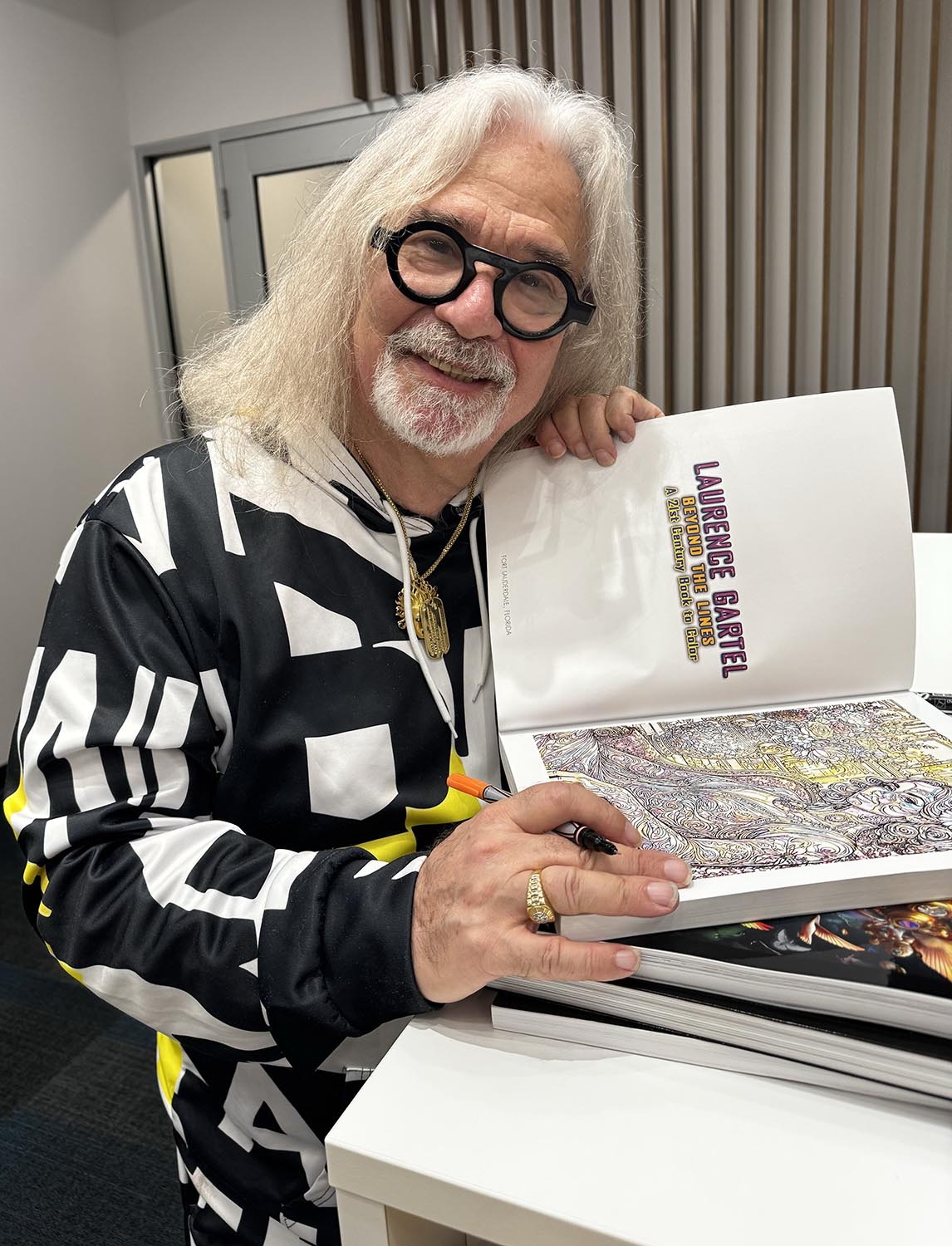
Laurence Gartel, born in New York in 1956, is an internationally recognized American artist and one of the foremost pioneers of Digital Art, frequently described as the “Father of Digital Art.” For more than fifty years, he has explored the relationship between creativity, technology, and social transformation, anticipating many of the visual languages that define contemporary culture.
After attending New York’s High School of Music and Art, Gartel earned a Bachelor of Fine Arts in Graphic Design from the School of Visual Arts. His engagement with electronic art began in the 1970s, when he worked alongside renowned video-art pioneer Nam June Paik at Media Study/Buffalo. Long before personal computers and digital image-editing software became widely available, Gartel was already experimenting with video synthesizers, analog systems, photography, and electronically manipulated imagery.
Growing up within New York’s vibrant cultural scene, at the intersection of contemporary art, punk music, and emerging technologies, Gartel encountered many leading figures of the avant-garde. In 1985, he also helped introduce Andy Warhol to the Commodore Amiga computer during the creation of Warhol’s celebrated digital portrait of Blondie singer Debbie Harry.
Gartel’s work has been shown at major international institutions, including the Museum of Modern Art and MoMA PS1 in New York, the Long Beach Museum of Art, the Princeton University Art Museum, and the Norton Museum of Art. His works are also represented in the permanent collections of the Smithsonian Institution’s National Museum of American History and the Bibliothèque nationale de France.
Throughout his career, Gartel has extended his distinctive visual language across photography, fashion, advertising, publishing, film, art cars, and public installations. He has developed projects for leading cultural and commercial organizations and, in 1990, created a pioneering campaign for Absolut Vodka. He served as the official artist of the 57th Annual Grammy Awards and contributed to NASA’s Magnetospheric Multiscale Mission through an artwork presented at the Kennedy Space Center in 2015.
His celebrated Art Cars have transformed Ferrari, Rolls-Royce, Tesla, Cadillac, and Mercedes-Benz automobiles into works of art in motion. In more recent years, Gartel has expanded his research into augmented reality, artificial intelligence, and robotic painting, demonstrating his enduring ability to engage creatively with each new technological frontier.
The year 2026 marked one of the most prolific periods of his career, bringing new exhibitions, publications, film awards, and projects combining Digital Art with robotics. His artistic journey was also celebrated in the retrospective exhibition “GARTEL: The Digital Art Breakthrough — 50 Years of Vision, Technology & Innovation.”
The author of numerous books devoted to his artistic research, Gartel regards technology not merely as a tool, but as a new territory for the imagination. His association with Tota Pulchra enriches the organization’s international network with an artist whose entire career has been shaped by innovation, creative freedom, and an enduring dialogue between art and the future.
Laurence Gartel, nato a New York nel 1956, è un artista statunitense riconosciuto a livello internazionale come uno dei grandi pionieri dell’arte digitale e spesso definito il “padre dell’arte digitale”. Da oltre cinquant’anni esplora il rapporto tra creatività, tecnologia e trasformazione della società, anticipando molti dei linguaggi visivi che caratterizzano il nostro tempo.
Dopo aver frequentato la High School of Music and Art di New York, ha conseguito il Bachelor of Fine Arts in Graphic Design presso la School of Visual Arts. La sua ricerca nell’ambito dell’arte elettronica ha avuto inizio negli anni Settanta, quando ha lavorato al fianco del celebre maestro della videoarte Nam June Paik presso il centro Media Study/Buffalo. In un’epoca precedente alla diffusione dei personal computer e dei comuni programmi di elaborazione grafica, Gartel sperimentava già con sintetizzatori video, sistemi analogici, fotografia e immagini manipolate elettronicamente.
Cresciuto nella vivace scena culturale newyorkese, tra arte contemporanea, musica punk e nuove tecnologie, Gartel entrò in contatto con numerosi protagonisti dell’avanguardia. Nel 1985 contribuì inoltre ad avvicinare Andy Warhol all’uso del computer Commodore Amiga, durante la realizzazione del celebre ritratto digitale della cantante Debbie Harry dei Blondie.
Le sue opere sono state presentate in prestigiose istituzioni internazionali, tra cui il Museum of Modern Art e il MoMA PS1 di New York, il Long Beach Museum of Art, il Princeton University Art Museum e il Norton Museum of Art. Alcuni suoi lavori sono conservati nelle collezioni permanenti del National Museum of American History dello Smithsonian Institution e della Bibliothèque nationale de France.
Nel corso della sua carriera Gartel ha applicato il proprio inconfondibile linguaggio visivo alla fotografia, alla moda, alla pubblicità, all’editoria, al cinema, alle automobili d’arte e alle installazioni pubbliche. Ha realizzato progetti per importanti realtà della cultura e della comunicazione e, nel 1990, ha firmato una pionieristica campagna per Absolut Vodka. È stato artista ufficiale della 57ª edizione dei Grammy Awards e ha collaborato alla missione Magnetospheric Multiscale della NASA, celebrata con un’opera presentata al Kennedy Space Center nel 2015.
La sua produzione comprende anche celebri Art Cars, attraverso le quali automobili Ferrari, Rolls-Royce, Tesla, Cadillac e Mercedes-Benz sono diventate vere e proprie opere d’arte in movimento. Negli anni più recenti Gartel ha esteso la propria ricerca alla realtà aumentata, all’intelligenza artificiale e alla pittura robotica, confermando la sua instancabile capacità di confrontarsi con le tecnologie emergenti.
Nel 2026, uno degli anni più intensi della sua attività, ha presentato nuovi progetti espositivi ed editoriali, ricevuto riconoscimenti cinematografici e sviluppato opere nelle quali arte digitale e robotica si incontrano. La sua produzione è stata inoltre oggetto della retrospettiva “GARTEL: The Digital Art Breakthrough — 50 Years of Vision, Technology & Innovation”.
Autore di numerosi volumi dedicati alla propria ricerca artistica, Gartel concepisce la tecnologia non come un semplice strumento, ma come un nuovo territorio dell’immaginazione. La sua adesione a Tota Pulchra arricchisce la rete internazionale dell’Associazione con una personalità che ha fatto dell’innovazione, della libertà creativa e del dialogo tra arte e futuro la cifra distintiva di tutta la propria opera.


